
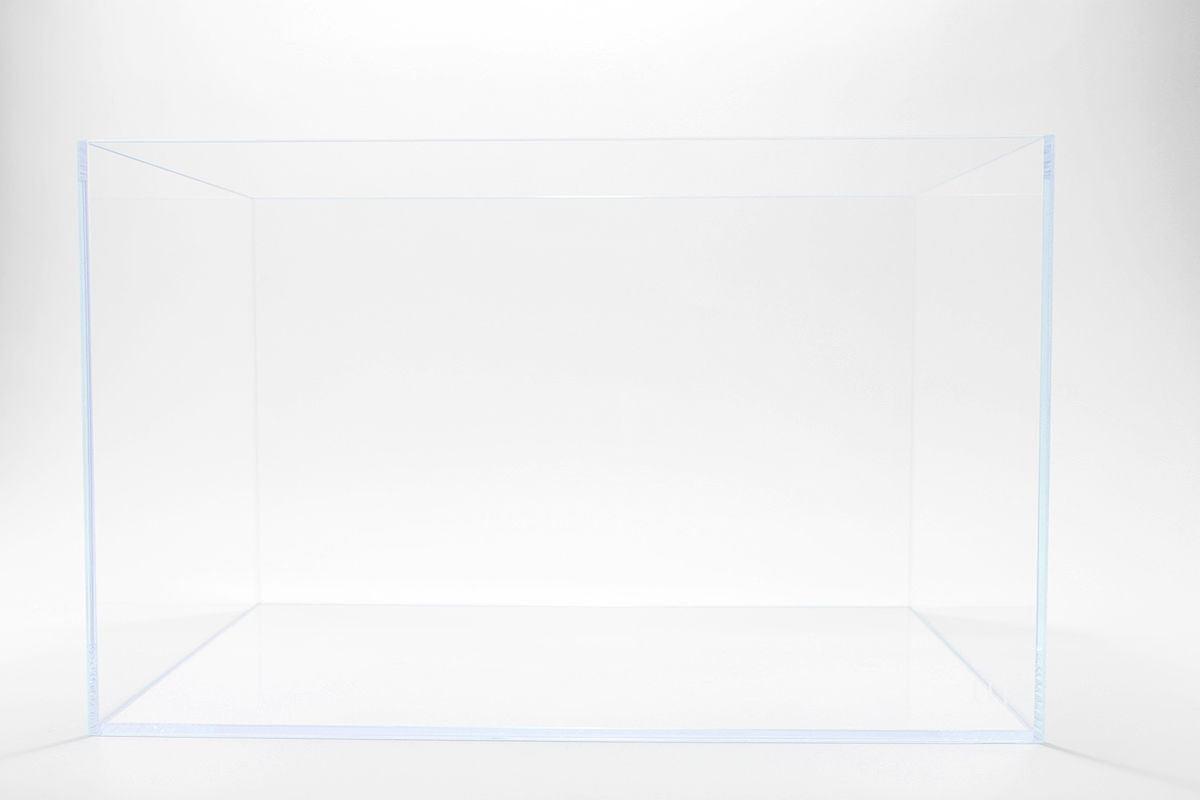
A rimless tank is the first thing most people notice in a nature-style aquascape. With no plastic frame around the top, the glass edges disappear and the layout reads like a slice of a riverbank. At Pet Zone we carry the Ultum Nature Systems (UNS) Ultra Clear line, and the question we hear most at the counter is simple: which size should I get? This guide walks through the UNS sizes, what each footprint is good at, and what to sort out before the tank goes on the stand.
Why rimless, and why low-iron glass
Standard aquarium glass has a slight green cast that you can see when you look through the edge of a panel. UNS Ultra Clear tanks use low-iron glass, which cuts most of that tint, so plant greens and fish colors look closer to how they really are. The trade-off of a rimless design is that there is no frame hiding the waterline, the silicone or the equipment, so a clean, minimal setup matters more. Glass lily pipes, a tidy cable path and a simple lid go a long way.
How to read UNS tank names
UNS names most tanks by length in centimeters plus a letter for the shape. A 20C is a 20 cm cube, a 45 is about 17.7 inches long, and a 60 is about 23.6 inches long. The letter tells you the proportions: the same 60 cm length comes as a low, narrow 60L, a wide and shallow 60S, or a tall 60U. Use the dimensions below rather than the name alone when you plan your space.
UNS Ultra Clear sizes at a glance
Dimensions are length x width x height in inches. Volumes are the glass volume; once substrate and hardscape go in, the real water volume is noticeably lower.
- 20C (7.9 x 7.9 x 7.9, about 2.1 gal): a desktop cube for moss, a few stems or a shrimp jar-style scape. View the 20C
- 3N (12.2 x 7.5 x 7.5, about 2.9 gal): a small rectangle that fits a shelf or desk. View the 3N
- 3T (12.2 x 7.5 x 9.4, about 3.7 gal): the same footprint as the 3N with extra height for taller plants.
- 5N (14.2 x 8.7 x 8.7, about 4.6 gal): a popular first planted nano with room for a simple stone layout. View the 5N
- 45S (17.7 x 11 x 7.1, about 5.9 gal): shallow and wide, a great carpet and Iwagumi tank. View the 45S
- 60L (23.6 x 7.9 x 7.9, about 6.3 gal): long and low, good for a narrow shelf or a riverbed-style layout. View the 60L
- 45U (about 17.7 inches long, roughly 9 gal): a compact standard tank that suits most beginner planted builds. View the 45U
- 60S (23.6 x 14.2 x 7.1, about 10.2 gal): a big, shallow footprint with lots of depth front to back for perspective. View the 60S
- 60U (23.6 x 14.2 x 14.2, about 20.5 gal): the classic 60 cm scaping tank, with room for a full layout and a community of small fish. View the 60U
See every size we list in our UNS collection and the wider aquariums and tanks range.
Shallow, standard or tall: matching the shape to the plan
Shallow tanks (45S, 60S)
Low water depth means light reaches the substrate easily and your hand reaches the back corner without getting your sleeve wet. That makes shallow tanks the easiest way to grow a carpet and to build stone layouts where the hardscape is the star. The catch is that tall stem plants run out of room fast, and there is less water for fish.
Standard and cube tanks (20C, 5N, 45U, 60U)
These are the all-rounders. You can slope substrate from front to back, mix a foreground carpet with midground plants and a few background stems, and keep a small school of fish. If you are not sure what you want to build yet, a standard tank leaves the most options open.
Long and low tanks (60L)
A 60L gives you a long, narrow view that works on a shelf, a credenza or a desk. It suits river and stream layouts with sand and pebbles running the length of the tank, mosses and small epiphytes like Anubias and Bucephalandra.
Nano tanks: small glass, bigger swings
Tanks under about 5 gallons are fun and affordable, but small water volumes change quickly. Temperature, evaporation and water chemistry all move faster than in a larger tank, so regular small water changes and a reliable heater matter. Nanos are a good fit for shrimp, a single betta or a few nano fish rather than a busy community. Browse our shrimp and invertebrates if you are building a nano for inverts.
Before the tank goes on the stand
- Level and flat surface. A rimless tank has no frame to spread the load, so it needs a flat, level surface that supports the whole base. A leveling mat under the glass helps cushion small imperfections. Check level front to back and side to side before you fill.
- Plan your filtration and lighting. Hang-on lights and clear glass inflow and outflow pipes keep the open look. See our lighting and filters.
- Pick substrate for the plants you want. Active aquasoil suits most planted layouts; inert sand works for stone and riverbed looks. Our planted tank substrate page explains the difference.
- Think about a lid. Rimless does not have to mean open-top if you keep jumpers or want less evaporation. We list rimless tank lids for that.
Quick picks
- First planted tank on a desk: 5N or 45U.
- Carpet or Iwagumi stone layout: 45S or 60S.
- Shelf or credenza: 60L.
- Full aquascape with a school of small fish: 60U.
Come see the glass in person
Low-iron glass is easier to appreciate in person than in a photo. Stop by and look at the tanks on display, bring your measurements, and we will help you plan the whole build from substrate to lighting. Stock changes often, so please call ahead to confirm sizes at 866-MY-FISHY. Online orders can be shipped or picked up at our Convoy store. If you want to learn hands-on, check our aquascaping classes and events.